Duolingo has taken the world by storm and seems to be the most common app for learning languages now. The number of users surpasses the number of people actually taking language classes.
I started learning Polish with it last February after my son decided he wanted to learn Italian on it. I was looking forward to learning a language again from scratch. I chose Polish since it’s relevant in the community and school where I started working a few years ago.
What I quickly discovered is that although Duolingo can give you individual words and sentences, overall it’s pretty decontextualized. One question in a lesson might be to translate “Man and woman”, and the next one is “I drink coffee”. As a language teacher, the lack of context, let alone comprehensible input, started to drive me insane.
I discovered that ChatGPT can create the comprehensible input and contexts that I wanted for expanding my study of Polish. Conversations that I have with Polish speaking students and coworkers are essential as well, but for self-study and comprehensible reading material, ChatGPT has really filled in the blanks in ways that I couldn’t have predicted.
I want to share with you how I’ve used ChatGPT to learn Polish, but way beyond “how do you say”, “translate this”, or “give me an example of”. I will show you examples of how I’m building my own language learning sandbox by using ChatGPT. This can help you in your language learning journey, and I feel that it has potential to help language learners in our classrooms also.
First, I started a ChatGPT project for my learning. This is a feature of ChatGPT that a lot of people don’t use enough, and it’s available on all versions. A project is a self-contained little world within your ChatGPT account where you can establish a set of rules or boundaries (I’m a beginner, I want to chat with my students and their parents, etc), and anything you do within the project is applicable to and “known” among all chats you do within the project. I contain all my chats and lists of things I’m doing in Polish within my “Polish learning” project.

All of my vocab lists, grammar questions, stories, pronunciation breakdowns, conversation practice, and “How do you say” chats are contained within this project, as separate chats. However, the advantage is that each topic I ask about knows what we’ve worked on inside other chats. Also, the “project” knows that I speak Spanish and Mandarin, and will frequently take comparisons from those languages to make comparisions to Polish.
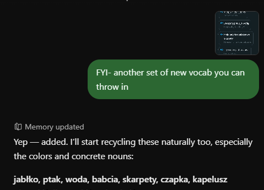
One major chat I keep inside the project is an ongoing list in which I constantly tell ChatGPT what vocabulary I’m learning in Duolingo. Sometimes I even take a screenshot of my vocab lists for a unit, and then ChatGPT knows that it can use that vocabulary for anything it puts together for me. You can ask it to save your vocabulary as a “memory” within the project, and you can keep updating it as you go along.
I get comprehensible contexts for Polish with ChatGPT. ChatGPT is what puts Polish into context for me, and has been the main driver of my learning. Here are some examples.
One of the most significant endeavors that I have going is a graded-reader of the book of Genesis in the Bible that ChatGPT is making for me. One powerful way to learn language is to take something that you’re familiar with and learn about it in the language you’re learning. The SOMOS curriculum in Spanish has units with “The Three Little Pigs” and “The Solar System”. Some people wonder why, but there’s a reason: by reading narratives in a different language that you’re already familiar with in your first language, your brain can observe what vocabulary and grammar is used to express it, and you can pick up a lot based on your background knowledge.
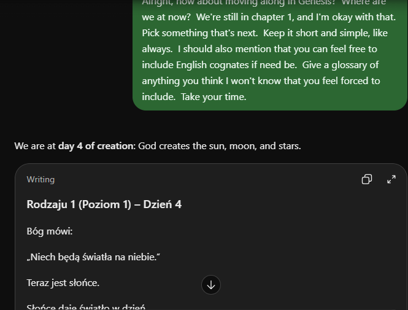
I decided to start at the beginning with the creation story in the book of Genesis. One day I asked ChatGPT to take the first part of Genesis 1 and retell it to me in simple Polish, in present tense, and to take into account any previous vocabulary within the project. I started that months ago and have kept going, asking it for 2-3 chunks a week. I’m currently in Genesis 5. I am copying and pasting complete chapters of my graded easy Polish Bible reader onto a Google Doc for long-term keeping and for rereading.
I could potentially keep the Bible reading going on forever and ever, using simple vocabulary. I have been able to learn words like sun, moon, sky, stars, trees, flowers, snake, kills, fruit, and much more vocabulary by getting this preschool level reader, all generated within seconds. I have often found too much unknown vocabulary and ask ChatGPT to dumb it down even more, and it does so with no problem.
In addition to the ongoing Bible reader, I have an ongoing story between two characters going. ChatGPT came up with a story about two kids named Adam and Maria a few months ago, and after I’ve learned new vocabulary, I ask it to generate a new installment in the story. I intentionally ask it to incorporate new vocabulary and grammatical structures into it that I’ve got from Duolingo. I sometimes remind ChatGPT to keep it in present tense and very comprehensible, including a glossary of new vocabulary when needed.
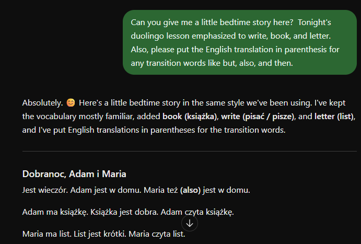
This has been the context in which I’ve learned words like “then”, “asks”, “smiles”, and other words you would normally find in a story between two characters living daily life. I have asked ChatGPT to take what it’s giving me in the Genesis Bible reader – found within the same project – and apply some of those things to the Adam and Maria saga. After reading the Genesis story of the snake in the Garden of Eden, ChatGPT generated a story about Maria going into their backyard garden, and Adam jokes about seeing a snake.
Eventually I will want to get to the point in which I can read magazine articles and books in Polish, but I’m not there yet. ChatGPT can generate reading content for me at my level and incorporating other content that I’ve been learning from Duolingo, the Bible reader, and anything else I’ve asked it to teach me.
ChatGPT makes grammar doable. I have really learned to deprioritize grammar with my learning, which is the first time in my language learning life that I’ve actually done so. But since I have an analytical brain when it comes to language, I have all sorts of chats within my Polish Learning project in which I ask ChatGPT about the grammar structures of the text I’m working with. I often ask questions about grammar on the spot within a story I’m working on. “Why is the word for ‘fruit’ owoce in one part of the Garden of Eden story, but owoc elsewhere, and then owocu in another spot?” ChatGPT will give me an organized explanation.
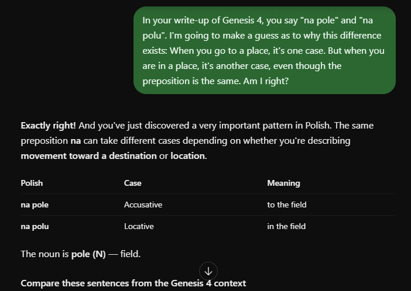
Instead of just doing raw grammar drills with isolated sentences, which is what I would get from a grammar book, using ChatGPT allows me do the following:
- ask grammatical questions within the comprehensible contexts I’m already working on
- compare grammatical concepts with English, Spanish, and Mandarin
- generate grammatical drills on the spot: “Thanks for that explanation; give me five drills with that”
- give me explanations of things when I’m ready for them and actually want them
You can’t buy a book about Polish grammar that compares it to Spanish or Mandarin. ChatGPT is that source for me. You can’t get five grammar drills that are based on something you just read only from a textbook, but ChatGPT does this.
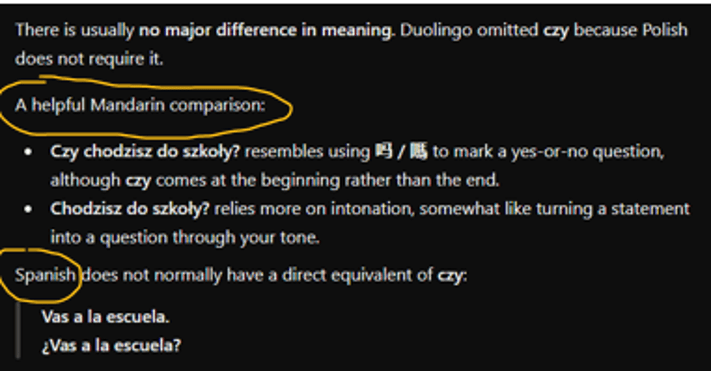
I have also asked ChatGPT to ask me personal questions incorporating recent vocabulary and grammar I have been working on. It will give me a list of questions about my life – “How often do you… Do you like this or that… What do you do on the weekends…” and then I can type in answers and get instant feedback. If I don’t understand a question, I can tell it that.
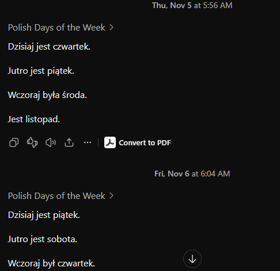
I start everyday with a pre-scheduled pop-up with the day of the week, date, and “how often” question. Many people might not realize that you can ask ChatGPT to remind you of things, or make something pop up on the app that you ask it to. I recently started working on months and days of the week on Duolingo. So about three weeks ago, I asked ChatGPT the following:
For the next three weeks, can you pop up in the morning just with a sentence about what day it is? Just tell me in Polish “Today is… Tomorrow is… Yesterday was…” I don’t think that there’s any response needed on my part unless you have any creative ideas. How about this pops up at 6:00am everyday for 3 weeks?
I eventually asked for it to evolve into asking questions about what day/date it is, but just have it answer the questions – “What day is it today? It is Tuesday. What month is it? It is November. How often do you go to school? I go to school everyday.” You can alter or adjust the task at any point you want, and ChatGPT will update it for you. On Thanksgiving, I learned how to say “Thanksgiving” and “celebrate”. I also recently asked it to start leaving ten lines of space between each question and answer so I could try to state the answer in Polish first before seeing it written out.
Conclusion
I know that there are lots of questions about AI and its effects on learning and education. I maintain that AI is best when it amplifies and expands our intelligence, not replaces it. I have come to discover that ChatGPT serves as a spectacular space to take basic words and phrases you’re learning in a language and create contexts, reading materials, questions, and overall content for yourself – material that is often not available especially in LCTL’s (less commonly taught languages) such as Polish. The next step for me as an educator is to figure out how I can guide my students to use ChatGPT for their own language learning in a fruitful way. Let me know how your own journeys go!


